

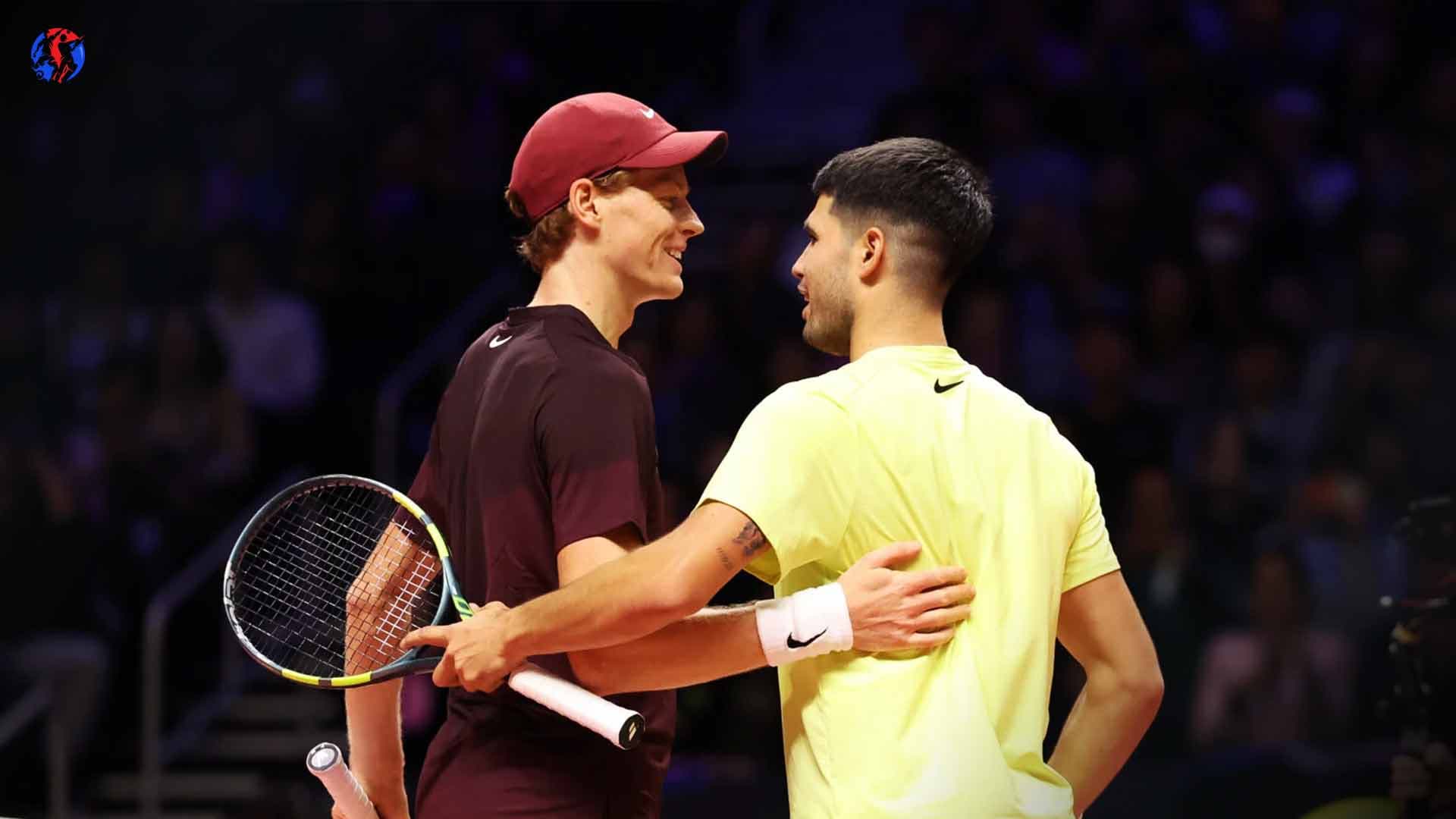
There was a period when men's tennis seemed almost assured in its brilliance. During the time of Roger Federer and Rafael Nadal, later accompanied by Novak Djokovic, they collectively shaped an era that many believed was unmatched. Yet as that generation started to withdraw, the sport has not declined. Rather, it has discovered a fresh pulse in the competition between Carlos Alcaraz and Jannik Sinner. Their recent encounter at the Monte Carlo Masters on April 12, 2026, where Sinner triumphed in straight sets, was more than just another final. It seemed like another sign in a competition that is starting to shape this period.
Throughout continents and terrains, the two have encountered one another repeatedly, frequently in critical moments. Exams have turned into a routine environment. Grand Slams, Masters tournaments, and the year-end championships have all witnessed them competing on different sides of the net. It is not only the frequency of their meetings, but the timing of those meetings that has added significance to this rivalry.
Alcaraz holds a 10-7 advantage in their head-to-head record. However, the figures reveal only a portion of the narrative. The momentum has changed several times, and that is what sustains it. The 2025 season showcased that equilibrium effectively. Sinner’s triumph in the Nitto ATP Finals final was remarkable, not only for the outcome but also for its significance. He maintained his composure during crucial moments and demonstrated that he could confront a player who had frequently matched him up to that point.
That conviction continued at Wimbledon, where Sinner halted Alcaraz’s streak, and in Monte Carlo this year. A sense of tranquility surrounds Sinner now. His approach focuses more on managing points than on pursuing them. He takes in pressure and bides his time for the perfect moment to attack.
Alcaraz, however, continues to be the more dynamic force. His victory in the 2025 US Open final demonstrated how swiftly he can dominate a match against an opponent. Once he discovers his flow, the diversity in his play becomes hard to manage. Their five-set clash in the French Open final remains vivid in memory, not only for the level of play but for the way it fluctuated right up until the finish.
Even when not during finals, their games have held significance. The 2022 US Open quarter-final, which extended late into the night, was an initial indication. Since then, gatherings in Indian Wells, Miami, and Beijing have further contributed to the feeling that this is a rivalry developed over time, not merely during major events.
What makes this stage of tennis intriguing is the lack of a singular dominant player. For many years, the sport centered on three individuals. It seems more spacious now. Alcaraz and Sinner are not taking the place of the Big Three in the same manner. Instead, they are creating something unique. A competition grounded in equilibrium rather than dominance.
Their styles highlight that distinction. Alcaraz relies on his instincts, frequently improvising and taking chances that can swiftly alter the direction of a rally. Sinner is more calculated. He scores points, depends on timing, and minimizes mistakes. It is a successful contrast, as it compels both to continually adapt.
There is a feeling that this is merely the start. At 22 and 24, they continue to learn, enhance, and understand one another. The distance between them is narrow, and it doesn’t remain constant for long.
For now, Sinner may have the edge in recent finals. But that edge feels temporary, like most things in this rivalry. And perhaps that is why it matters. Tennis, after years of certainty, has found something less predictable but just as compelling.